

The Other Part: A Sermon

I preached this sermon on Sunday, January 26, 2025 at St. Anne Episcopal Church, West Chester, OH. The lectionary text cited is Luke 4:14-21, Jesus’ teaching in the synagogue at Nazareth.

It was the 5th grade, and I was about 10 years old, and I was enraged. When I tell you the reason, it will sound so trivial, but the stakes of things can feel big when you’re young. 

Here’s the situation: I was in an after-school drama program where we picked a scene from any play to perform for parents and friends. I was really into theater as a kid, and so I took this very seriously. At 10, I was obsessed with Greek mythology (and yes, I know how nerdy that makes me sound, but so it was). And so I’d picked a scene from the ancient Greek tragedy Prometheus Bound for my partner and I, mainly because I wanted to play the role of the Greek god Hermes. It was my 10-year old dream in life to play the part of the Greek god Hermes. Did I mention I was not a particularly popular kid? 

No matter. I’d picked out the scene and it was so good—Hermes, the messenger of the gods, comes to visit the mortal Prometheus, who is punished for stealing sacred fire from Mt. Olympus and giving it to humanity for those mundane things like staying warm and cooking food. And as Hermes, I would get to show up and make a solemn speech about all the ways Prometheus had violated the sacred order of the universe. It was going to be my shining moment as a Greek god!

And then, a nightmare situation: the teacher watched us rehearse and decided that, in fact, I should play Prometheus and the other kid would get to be Hermes. My dreams were dashed. He got to wear the cape and the fancy helmet and I had to be some sad, angry man tied to a chair, ranting and raving about justice. The indignity!

I won’t bore you with all the details, but the short version is that I did indeed end up playing Prometheus in that little scene, and among all the parts I ever played, I think it was the one that stuck with me most. Because what I couldn’t see at the time-what that wise teacher recognized-was that there was something deep within my own heart that needed to be set free by playing the other part. I am grateful, now, that that teacher dared challenge the part in which I had cast myself. 

I wonder, though, friends—I wonder how often we are willing to let ourselves be challenged in the parts we have cast ourselves. I wonder what we do when the truth comes knocking insistently, telling us that we were meant for something more, something different than that to which we have become accustomed? Do we admit willingly, yes, oh, yes, of course, you’re right, my whole life has been built upon a pile of half-understood desires and misinterpreted signs. Or do we, perhaps, become a little bit enraged that someone dares challenge our carefully constructed sense of ourselves? 

Jesus learned something about this in Nazareth after his teaching in the synagogue. Lamentably, our lectionary skips over a big part of this story. Because after saying “this scripture has been fulfilled in your hearing” Jesus tells his hometown crowd, in so many words, that their understanding of themselves as the only victims, as the only ones who will receive God’s mercy, is completely misguided—because God’s scope of concern includes not just the poor, the captives, and the oppressed on their side of the cultural and political divide, but also the ones they fear and resent. 

Well, after hearing that, they don’t want to just tie him to a rock, they try to throw him off the top of a cliff. Tough crowd. 

But we can’t be too hard on the crowd in Nazareth. Because every single one of us, in one way or another, would benefit from some reflection on the scope of God’s mercy, and how it includes those vastly different from us—and how Jesus’ message requires us to play a part in this world perhaps different from the one we would prefer.

A lot of ink has been spilled this week about the part that the church ought to play in political discourse in our country. The sermon offered by Episcopal Bishop Mariann Edgar Budde this past Tuesday has generated, shall we say, keen interest among those both in support of what was preached and those outraged by it. 

And it’s true, the mercy of God is outrageous. But what I found interesting in the debate is that there wasn’t much critique of the sermon’s content—which was, after all, taken directly from that useful preaching resource called the Bible. No, the complaint is mostly that it was an inappropriate time or place to say what was said. That it’s not the church’s role to speak into our civic life. That a direct plea for mercy towards the vulnerable, and especially towards those perceived by some as enemies, was a disturbance to the civility of the occasion. And yes, I suppose it was a disturbance of sorts. 

But I hate to have to remind us all, 2000 years on from the death and resurrection of Jesus, but placid civility in support of the current social order is not the primary goal of coming into a church, as much as we have become accustomed to the church taking on that role. 

Really, this whole uproar has helped me realize that the real problem is that too many folks think the church is just there as a sort of spiritual backdrop to their own headlining role in the world. That it’s just The Universe, starring Me and My Opinions. But then there’s that pesky gospel of Jesus Christ, always getting in the way of my good time. 

No matter our outside affiliations, we would all do well to remember the part we are called to play when we step through these doors and into the liturgy–into an encounter with the sacramental and Scriptural presence of the Living God.

We would do well to remember that none of us is the main character in this play, that this is an ensemble piece, and that, whether we are a president or a pauper or Prometheus himself, we dare to come here to consider a power greater than any one of us and to which all of us will be held accountable in the end: the power of love, and truth, and justice, and yes, unfailing mercy, which Scripture teaches is the yardstick by which our lives will be measured.

And so today, as we consider with some urgency the role we and our church are to play in the present moment—on this day I would ask us to consider: do we understand what we are supposed to be about in this place? Do we understand that Jesus doesn’t just draw us here, week after week, to give us a snack and a pat on the head? Do we hear Jesus’ call upon our lives–his disturbing, surprising, humbling, but ultimately transformative invitation–to be like him, to take on his part in the world, to live as he actually lived, to die and rise again with him—liberating the oppressed, healing the sick, bearing good news to the poor, repairing the breach, trusting that love is more powerful than death and more important than mere civility? 

Because the curtain is up now, friends, and the world is waiting for us to act, and the old bit parts we’ve been playing at aren’t going to cut it anymore. If you want untroubled civility….and an unexamined conscience…and an easy peace with the world as it is…then I’d say be careful coming into an Episcopal Church, because you might get more than you bargained for. You might get the whole story about how God loves you and how God loves everything and how God expects us to love each other unconditionally. We’re a whole lot of fun, I promise, but when it comes to speaking truth and living in love, we’re not playing around. Kind of like Jesus.

And it can feel scary sometimes to take on that part, I know. When I am tired and fearful, sometimes, I still say, gosh, God, couldn’t I just go back and play the part of Hermes—couldn’t I just stay aloof, untouched by sorrow, detached from the risks and the mess that love requires? And God sees me, and loves me, and says…no. 

So be it. 

St. Anne, we were meant for a life big enough, bright enough, brave enough to make those old gods on Mt. Olympus shudder. We were meant for the life of Jesus: uncivil and gentle and beautiful and true. And that life is now ours to live out, ours to share, ours to bring to bear upon the public square and in the deepest chambers of our hearts. It is the life we were created for.

It is the role, however surprising, that we and the whole church were born to play. 
The Fire That Never Came: A Sermon

I preached this sermon on Sunday, January 12, 2025, the Feast of the Baptism of Our Lord, at St. Anne Episcopal Church, West Chester, OH. The lectionary text cited is Luke 3:15-17, 21-22.

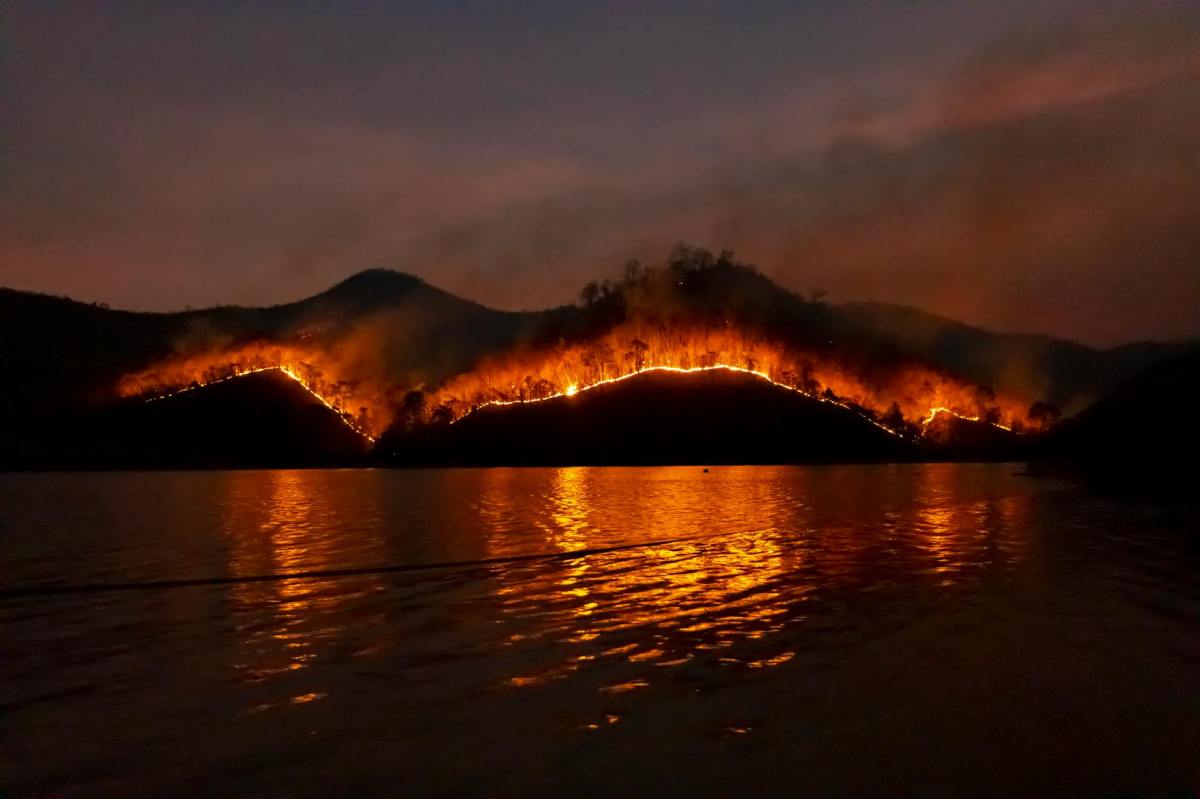
I’ve shared with you in the past how, when you live in California, you become acquainted with the risk of wildfire. You make an uneasy peace with it. Much of the year it’s in the back of your mind and then, when the risk level is high, you look nervously towards the hills, wondering if and when something might spark. 

But because you never really know, most days you go about your business and go to work and do the dishes and pay the bills, carving out a sense of normalcy and telling yourself that, if it does happen, if the fire does come, somehow you will manage. Or maybe, in your less noble moments, you just figure it will happen to somebody else.

But the fires do come, in their own cruel time and manner, and it is hard to be prepared when they do. As we’ve seen this week in Los Angeles—as some of you know intimately well through the impact on friends and family members—the fires come without much warning, and they blaze and they creep up upon the homes and lives of people without much regard for their wealth or background or virtues or vulnerabilities. 

They come, these fires, and they do what fires do—they consume. We know already this week of Episcopal churches and whole communities consumed by this most recent set of wildfires. We also know that we are living in a time when human-impacted climate conditions will only continue to increase the likelihood and intensity of such events. The unquenchable fires have come. 

And maybe it’s just me, maybe when you grow up with this threat of flame and smoke, it has a formative effect..but I have to say that, as evocative as it is, I find little that’s romantic or alluring about most of the fire imagery in Scripture. I’m circumspect about declarations, like the one that John the Baptist makes in this morning’s text, about how God will come and burn and consume things for some divine purpose. There is nothing pretty or transcendent about that. Not when you have seen or known what fire can actually do, what it can take.

And yet that imagery is there for us to contend with. John, admonishing the crowds before Jesus’ appearance, warns of a Messiah who will come bearing unquenchable fire to burn up all that is wicked and unworthy. And I get it, he is angered by injustice and wants the people to look a bit nervously toward the hillsides, wondering when their reckoning will come. As prophets often do, he wants them to experience an uneasy peace with the world as they know it. He assumes that God will save the world through a display of vengeance and power, in billows of smoke and flame. 

He is not alone in that, even today. I found a number of news articles this week in which people described the Los Angeles wildfires as “biblical” and “apocalyptic” and as being like a scene from “the battle of Armageddon.” Still, still, even if we don’t want to, we imagine and speak of God working through destructive forces, raining down judgment upon us like ashes, threatening at any moment to take away all that we know, or, in our less noble moments, to come and take from somebody else. 

I wish we could loosen our grip on that fiery imagery somehow. Because I will tell you that so much of why I am Christian, why I was able to give my life over to the way of Jesus, is because of what actually happens in today’s Gospel after John’s dire predictions. 

And it is this: that Jesus, the Son of God, appears in Galilee, the Incarnate Deity appears at last, coming over the hills…but the fire never comes. Not in the way that anyone expected anyway (and Pentecost is a story for another day). 

No, on this day Jesus appears and it is not as a vengeful blaze cresting the ridge, but as a man ready to get down into the water like everyone else. A man ready to come alongside all of us in the uneasy peace we have negotiated with this life. A man who wants us hope for something more than mere escape and to believe in something more than just survival.

And truly, thank God for that. Because I will tell you, my friends, I am tired of fires, and of people who blithely traffic in the language of fire when talking about God and our common life. I am sick of “burn it down” and “let it burn” and of fire & brimstone theologies that devour human dignity in the name of purgation. I am sick of destruction—of bodies and landscapes and souls—and how they are cast as part of God’s saving mission. 

I don’t want to settle for an uneasy peace anymore. I want the peace that the world cannot give, the peace born of water and Spirit. And today we see where it comes from—from the God who stands in solidarity with us in the River Jordan, whose only fire is the one burning in his heart with love. 

Because John, for all his Spirit-inspired wisdom, got this part wrong, and it’s important that we don’t just read past his mistake. There’s a reason, in other versions of the story, that he is actually somewhat dismayed Jesus wants to be baptized with water. There is a reason, later from prison, John asks, are you the one we have been waiting for

Because John himself is also discovering, as we must, that the true Messiah, the Christ, is not an inferno coming to gobble up everything we’ve tried to build; God is the one strengthening us and helping us to carry those buckets of water– all that blessed baptismal water–to put out all the fires we ourselves have started on this earth. 

And yes, God will help us separate the wheat from the chaff within ourselves and in our world, but God will do so not through devastation but by the devastating power of his mercy and kindness.

And the thing is, we already know this. We already know, if we stop to reflect on it, where and how God shows up in the world. We know that God is not the one burning the hillsides of Los Angeles or blessing the gunfire in war zones. We know that God is instead with the firefighters and the first responders and the widows and the orphans and the volunteers and the communities of people who are sheltering each other and guiding each other into safety. 

We know that Christ asks us to do the same for each other no matter what landscape we live in or what disasters befall us. We know this, because it is what Jesus demonstrated and proved the value of in his life, death, and resurrection. And we can’t let anyone distort this truth.

No matter what we must navigate in our time and in times to come, no matter how many times the fire looms at the edge of the horizon, we are still, and will always be, the people who proclaim the good news of the one fire that never came—that so-called fiery, angry God who instead appeared in the water, like a falling dove, like a gentle Word, stooping down from the misty heavens to scoop up our fears in his hands and bless them and say,

Peace. I am here. You don’t have to be afraid anymore, you who have been uneasy for so long. Step down into the water with me, where the flames cannot reach.

Drench yourself in love, and let us begin again. 

By Another Road: A Sermon

I preached this sermon on Sunday, January 5 at St. Anne Episcopal Church, West Chester, OH. The lectionary text cited is Matthew 2:1-12, the journey of the Magi to see the baby Jesus.

Some of you know that I post the text of my sermons each week on a little blog site I created several years ago. I’ve always loved writing, and it started out as a helpful way for me to share some of my early sermons and reflections with a few family members and friends. It has transitioned into, I hope, a convenient way for anyone to go back, if they want to, to see what exactly I was attempting to say on any given Sunday—whether because you found it interesting, or perhaps because it made no sense at all. I make no promises! 

It is the humbling labor of a preacher each week to launch out our words as an offering to the community we serve and out into the universe as an offering to God. We hope, at best, to leave behind a small impression—which can feel like trying to skip a stone on the surface of the sea.

But I digress. The blog where I post my sermons and skip my stones is titled By Another Road, and folks have asked me on occasion why it’s called that. Well, in this morning’s Gospel reading, you have your answer. I took it from Matthew’s account of the Magi (or Wise Men) who, after visiting the baby Jesus and having been warned of King Herod’s nefarious intentions, decide to travel home “by another road.” 

On its face, this little phrase is just part of the plot—the Magi literally have to go home a different way in order to avoid an awkward or dangerous conversation with Herod. They’ve accomplished what they came to do, paying homage to this newborn king, and now they slip down a back road to their own homelands.  

But for me, at least, this phrase, by another road, always meant something more. Maybe it’s because, for various reasons, I have known what it feels like to be “other” myself. When a person feels different somehow from those around them, you come to know what it means and what it costs to walk a road through life that some people cannot—or choose not—to understand.

This can be many things. For some, this “other road” is tied to an identity we carry with us; for others perhaps it is shaped by our personal or family history, or our physical limitations, or the unexpected responsibilities and challenges that life has visited upon us. The more I live and serve as a priest and hear people’s stories, the better I understand that we are all traveling “by another road” of one sort or another.

And what I became convinced of at a particular point in my walk with God, and which I fervently believe is the basis of our faith, is that the story of following Jesus is less about conforming ourselves to one straight and narrow, conventionally acceptable path, and instead is about opening our hearts and our eyes and our minds to recognize how God is present on every road we must travel. And that God is present, too, on the roads we do not recognize—the ones walked by people very different from us. 

The point of being Christian is found not so much in which road we take, but how we travel. Are we going gently and justly? Are we helping others along the way? Are we stopping to notice the beauty of the world around us and giving thanks for it? Are we treating those whom we meet as adversaries, or as fellow pilgrims? 

To travel by another road, ultimately, means seeing the world as the Wise Men did after their encounter with the Christ child—once they decided to opt out of whatever political intrigue they’d been drawn into. It is to see the world no longer as place of transactional relationships and personal ambitions, but as a network of winding paths—all our pasts and futures and sorrows and dreams, all converging, ultimately, beneath the star of Bethlehem, in the flesh of God, and in the humble gifts we offer to one another…all of us skipping our stones on the surface of the sea. 

And to be a follower of Jesus is to commit to walking whatever road we’re on as if all of this is true and worthwhile. Because in every worship service and in every act of service to our neighbor we affirm that it is—that God was born into this world to bless every pathway we have stumbled upon, and even to journey by another road of his own, to the Cross and beyond. 

Now, I’ll admit that the idea that there isn’t just one road, one perfect way to “do” this Christian life, and that—heaven help us—there might even be holy pathways for people who look or love or live differently than us— might be a bit disorienting, even offensive to some. So be it.

But I’ll tell you—it’s this realization–that God was with me on my own road, that Jesus wanted to walk with me just as I am–that saved me, and continues to save me every day of my life. And I suspect, because you have found a sense of home at St. Anne, that might be true for you, too.

Because the other thing I love about the story of the Magi is that they, themselves, discovered in their encounter with Jesus that it was ok to be different. They were not Israelites. They weren’t part of the in-crowd in this story. And yet God, as a child, welcomed them as any child would—full of love and trust and wonder. These Magi were enough, just as they are; they were loved and blessed not because of the particular road they have traveled, but simply because they have come. And so it is for you.

I hope we learn something from all of this. And so, if I could ask you to do two things, my dear friends, at the outset of this new calendar year, it would be this:

First—take some time to look at the road you’re on, whether in this past year or maybe for your whole life. Maybe it’s not perfect. Maybe it’s been hard. But I want you to kneel down and bless that road, and bless the body and soul that has carried you on it. 

I want you to trace a cross in the dust of this road you’ve been walking, trace a cross over the story you’ve been carrying in your heart, over the questions you’ve been asking, over the fears you’ve been fearing, and I want you to say to yourself, God is on this road with me. Jesus is on this road with me. And so I will travel it with my head held high, with a sense of love and purpose and care, because like any other road, it is made sacred by the journey.

And second—take some time to learn about the road someone else is walking. Maybe someone close to you whose life just doesn’t make a lot of sense to you. Or maybe someone you’ve lost touch with. Or maybe a community of people whose life experiences differ greatly from yours. 

In whatever way you can, whether through conversation or study, try to understand the road that they are walking. Maybe you can ask them those questions I suggested last November:  What do you love? What do you fear? What do you hope for? And another important question one of you added to that list: What can I do to help? 

Because the Epiphany that we speak of this time of year—the Epiphany of God’s revelation in our midst—is not just about the news of Jesus born in Bethlehem all those years ago, visited by wise men and feared by kings. 

No, the Epiphany is also that God is still here with every one of us, no matter which road we’re on—the winding roads and the dangerous ones; the placid pathways and the ones cut short; the long hauls and the dead ends. 

And we are now the ones who must be Wise Men and Wise Women and Wise People, putting one foot in front of the other, following that star, bearing our own particular gifts, so that kings and tyrants might yet tremble in the face of love and peace and mercy, both in the form of a child and in the ones who seek him—the ones, like us, who dare to travel by another road. 

A road which, no matter where it goes, always leads us home.