What Is Loved, Is Resurrected

I preached this sermon on Easter Day, March 31, 2024, at St. Anne Episcopal Church, West Chester, OH. A version was also featured this day as part of The Episcopal Church’s Sermons that Work.

“While it was still dark, Mary Magdalene came to the tomb and saw that the stone had been removed.”

What is loved, is resurrected. 

This is the proclamation of this singular, eternally true day. This is what we discover on this morning, as the dawn caresses the darkness and wipes away its tears. Just as sunlight reveals itself in the morning sky, so has the Son of God revealed his fullness, so that in the light of this impossible, wondrous moment, we, like Mary Magdalene, might finally behold God’s answer to our broken hearts:

That what is loved, is resurrected.

Because Jesus, who was so deeply loved, who is Love, has been resurrected. Or, more accurately, he IS the resurrection, just as he once told Martha as she grieved over Lazarus. He is Love and he is Resurrection, and now, at last, we see what had previously been hidden: that these two, love and resurrection, are the same thing. We see that love is not a temporary condition, not something that we must live in fear of losing; it is the fundamental premise of existence, it is the Alpha and the Omega. When we love, when we are loved, we are given a taste of eternity. 

And so Jesus, this Love enfleshed, stands before us, bathed in the dew of the garden, his voice as soft as flower petals, his heart as radiant as fire, and he has arrived, not at the end of his journey, but at the new beginning of our journey. At the new beginning of the world—again, as before, in a garden. A beginning that is again, as before, signified by the tenderness of a God who walks among the trees and seeks his children and calls out to them by name. 

But on this day, on the other side of night and on the other side of death, God has a new message to add: not simply that we are loved, for that has always been true…but that what is loved is resurrected. That love is resurrection, and that death is no longer a closed door. It is an empty tomb. 

It was not always evident that this would be so. 

Humanity has traveled a long way to get to this morning. Outward from the original, creative tension between chaos and genesis; outward from the garden of Eden; outward across a thousand wildernesses of yearning and temptation; traveling through the turbulent seas and across the river to the precarious, uncertain peace of our earthly promised lands.

And as we have traveled, humanity, in good times and hard, has always sought the one thing it could never have: a solution to the conflict between our affections and our mortality. In other words, that what we love, dies.

This has been the curse, this has been the bitten, bitter fruit of an inescapable insight: that even if our deep love—for God, for family, for spouse, for neighbor, for earth—somehow manages to endure over time, our bodies and the work of our hands do not. We are burdened with the degeneration of even our noblest efforts, the severing of our most precious bonds. The inescapable presence of death has driven the world mad with grief, desperate with the longing for something other than goodbye.

But today, in the strange dim light of Easter morning, a wondrous thing takes place. And not just the one you are thinking of. 

No, in fact, the first thing is this: that a disciple, Mary Magdalene, who has watched Jesus suffer and die, and who now carries the vast pain and loneliness of all creation in her heart, on a morning in which God is dead and Love is dead…she comes to the tomb. She comes to the grave of all human hope, knowing what has been lost, and she looks into the void where Love used to be…and yet she refuses to yield her love to that void.

Mary refuses, there, despite the literal death of Love itself, to give up the love she carries in her. She keeps that love alive in her broken heart. And so, on behalf of all of us, she comes to bear witness and to tend to God’s body when no one else is able or willing to do so, because she knows that bearing witness and tending to what is broken is what love looks like, both in life and in death. 

And in this moment of miraculous tenderness and strength, she, the stubborn bearer of a Love that was supposed to have been killed, is given to behold a new miracle:

That what is loved, is resurrected. 

Mary Magdalene did not resurrect Jesus, of course—the upwelling, earth-sustaining, heaven-rending power of the living God did that—but it is also true that, even as Jesus lay dead, this very same divine, undying love coursed through her veins and animated her soul and carried her to the tomb that day. 

It was God’s love, it was God’s own heart, in and with and through the heart of Mary Magdalene, who also wept beside the empty tomb, God weeping in her and with her and with us for the senselessness of separation, weeping for that long journey out of Eden, across the wilderness, through the seas, searching for something other than goodbye—a journey that God made, too, right beside us, step by weary step.

And so while Mary did not resurrect Jesus, we can say that she carried that same resurrecting love within herself, that she was an agent of and a participant in its surprising, vivifying force, and that she partook, in that moment, of the very same powerful, stubborn love that will ultimately restore all life back to life. 

And if she does, then so can we. 

What you need to know is this: the Resurrection of Jesus is not just a remote story of a bygone moment when something amazing happened; it is a statement about what is still true for you and for me and for everyone who is still navigating that long and often wearisome journey in search of something other than goodbye. For everyone who struggles to love; for everyone who has loved and lost; for everyone who feels confused about what love even is: Easter Day is the answer. 

What is loved, however imperfectly, for however long, is resurrected. 

This is what the risen body of Christ signifies and enacts: that what is loved is not lost to you, and it will live forever, not only as a memory, but in its fullness, in the flesh, on that day when God becomes all in all, and the whole earth is loved back to life. 

And, as Mary discovered, what you choose to love in this world is imbued with the promise of resurrection simply by the act of loving it. Every time you have gently kissed a soft cheek or held a calloused hand. Every time you have refused to break a bruised reed or trample a fragile spirit. Every time you have preserved the hope of the poor, or sought beauty, or made peace. Every time you have stopped to love something, you have taken part in the ultimate resurrection of the world, for what is loved—by you, by God, and by God working through you—is resurrected. 

Why and how is this so? How can Easter be what it is? 

We cannot explain it. We need not explain it. Because neither can we really explain our compulsion to love, even in the face of loss and uncertainty, and yet we simply do. Love is its own answer to the questions we ask. And resurrection is the same. 

Jesus emerges from the fading night, calling Mary by name, calling you by name, to confirm what you already knew in your bones but dared not trust: that love is worth the cost, it is worth having to say goodbye, because there is indeed, something other than goodbye at the end of the story, there is a place where beginnings and endings meet, where, forever, the dawn will caress the darkness and wipe away its tears and all that has been loved will be alive, and we will call each other by name. 

And in this strange new Easter light, perhaps we will realize that there was, in fact, always something deeper than mere human longing that propelled us across the wilderness and through the sea—that our long history of choosing to seek, to hope, to endure, to dream of something other than goodbye, was never a futile endeavor—it was a fertile one. It was the resurrecting love of God already at work in our mortal bodies, now completed in God’s body.

And like Mary in the garden, beholding the Risen Lord of flesh and flower and flame, perhaps we will discover that we, too, are bearers of that force which is stronger than death; that our choice to love is to take part in the very same mysterious, power that compels life to rise up from the earth.

For what is loved, is resurrected. 

Just like Jesus. 

And, one day, just like us. 
I’m Here: A Sermon for Good friday

I preached this sermon on Good Friday, March 29th, 2024 at St. Anne Episcopal Church, West Chester, OH.

Here we are. 

Here we are, at the Cross. At the place that is an ending, even if we pray that it’s not the end. It’s the day in the story that no one wants to think much about and yet that must be faced, eventually. The day that is full of dread and sorrow and pain and yet compels us in ways that are hard to explain. We are pulled in close on this day, challenged to listen and to look, challenged to stay, even if we would rather run far away, rather be anywhere else than here, in proximity to the tears and the sweat and the blood, holding vigil with a broken man as he weeps and dies. With a broken God as he weeps and dies. 

We do not enjoy this observance, and yet we come, on Good Friday, because somehow we know that we must come. Not out of a sense of religious obligation or detached piety. No, we leave all of that posturing far behind us if we are actually paying attention to the story, if we are actually open to it. Out here on Golgotha, where things are brutally spare and honest, where only the wind and the rock and the bones take note of our presence, out where even temples and empires have neither sense nor safety to offer, it is something deeper than duty that draws us.

We come here because we know, in a way deeper than knowing, that this is what love requires of us. We know, somehow, that showing up, that being present, that being able to look into someone’s frightened, tired eyes–into Jesus’ frightened, tired eyes–and to simply say, “I’m here,” is the most important thing that we can do when there is nothing else left to do. 

We know this because we know death all too well. We have lived it. If you have ever received that call or text that comes late in the night and you have rushed to be with someone who is gravely ill or dying, you know what I mean. You know how, as their eyes grow dim and their energy fades and their breathing changes, and then they are sleeping, and then they are slipping, and you aren’t even sure if they can hear you anymore…you know that you cannot do much of anything except say, “I’m here. I’m here. I’m here. I love you. And I’m here.” 

We feel helpless, then. And we are. And yet this is exactly what we need to do at such times. No big gestures, no eloquent words are necessary. Just, “I’m here.”

And so it is fitting, now, as Jesus dies, that we stop what we’re doing, that we come here from wherever we are in our lives and in our hearts. Not to fix anything or figure anything out. But simply to say to him: I’m here.

I’m here, Lord, even if we weren’t always as close as I’d hoped. 

I’m here even if I never fully understood you, even if I never felt fully understood.

I’m here, even though there are a thousand questions you never answered, and a thousand more I never asked. 

I’m here, even though I have doubted you, and I have doubted myself, I have doubted whether the type of love you talked about is even possible in a world as broken as this one. 

I’m here, even though I cannot bear to see you like this. 

I’m here, because I cannot imagine never seeing you again. 

I’m here, and somehow, I pray that it is enough that I am here, to hold your hand, to look into your eyes, to show you that you are not forsaken. 

I love you, and I’m here.

The strangeness of it all, is that, on this day, we are here consoling God as God dies, whereas for all the rest of our days, God has been the one drawing close to console us. Since the moment we were born, and as we grew up, and as we grew older and began to learn the cost of growing old, God has always been waiting, listening, watching, staying near. God has been ready, when we cry out in pain or fear, ready to drop everything, to come, to say, “I’m here. I’m here. I love you. I’m here. I know you don’t understand. And I can’t always fix it for you, but I’m here.”

Yet now, in the mysterious circularity of love, like children who must one day cradle their parents, it is our turn. Our turn to comfort our Creator, our Lord, our God, as he cries out and enters the darkness, enters death—the one and only place where he, being eternal, being God, has never been before. Our turn to help him feel a bit less afraid, just this once. 

Our turn, now, to be the one who is strong, the one who must endure, who must bear witness, who must show up, as God has always done for us. Good Friday is our turn to offer back the gift of presence, saying, yes, God, I know. It hurts to live. And it’s scary to die. I know. But I’m here. I’m here. I’m here. 

In other words, today is the day, spiritually, that we grow up, that we become the ones that he always longed for us to be. The ones who choose, in coming here, to no longer hide from death nor from pain nor from ourselves, because love compels us, above all, to show up, to stay present, no matter what. And because today, on the Cross, God, who never needed anything, who didn’t know what need felt like, now needs us. 

For he has traveled from farther than forever, and the trip has taken its toll. He has been wearied and winnowed down to the bone. He has spent all he had, and he has nothing left to give over except his body, and he is willing to risk be misunderstood and despised and mocked, all for the chance to come and find you and say those words from his own lips that God has been trying to tell us for all time: I’m here, I’m here, I’m here. I love you. I’m here.

As it turns out, all he ever needed was to hear us say it back.

What If?: A Sermon for Palm Sunday

I preached this sermon on Palm Sunday, 2024, at St. Anne Episcopal Church, West Chester, OH. The text cited is the Passion narrative in the Gospel according to Mark.

One thing that strikes me, every year, as Holy Week envelops us in the stark power of its narrative, is how inevitable it all feels, this story about Jesus’ betrayal and death. How fixed the trajectory, after lifetimes, after centuries, after millennia of retracing it. It is easy to forget that the story we tell today began so differently.

Just a few months ago, we beheld a baby born in Bethlehem under the chill of starlight, and we heard angel choirs singing of peace, and then we watched that child grow and mature through the soft gloom of the season, and in the slow lengthening of our days through Epiphany, we beheld his light and his life and his love gathering their own brightness, and we have looked for signs of the unfurling promise of his Kingdom, like springtime emerging from the muddy, fertile ground of Lent. 

And yet, once more, here we stand on Palm Sunday, only to witness this particular story of God’s goodness cut short again, this particular promise deferred again, the tender green growing palms trampled, again, under the force of misguided adulation; the gently stirring earth soaked, again, not with gentle spring rain, but with blood.

And yet, despite the grave horrors, the enduring shock of what we see and experience in this Passion story, still, I think, we tend to see it as inevitable. As if this brutal end to Jesus’ earthly ministry was somehow the necessary price of his message, as if it were normal for for mothers to mourn their children, as if it were normal for springtime to give way to winter instead of summer. As if this sacrifice was as natural as the turning of the seasons. As if there was no other way the story could have ended. 

What if there was?

It’s odd, we rarely seem to ask that question about Holy Week. And it’s especially odd because, for most of us, in our own lives, we spend a lot of time and energy asking “what if?” 

What if I had made a different choice? What if I had chosen a different path? What if I had learned from my mistakes sooner? What if we, as a nation or as a community or as a church had chosen another course of action? 

Asking these sorts of questions is, most of the time, as natural as breathing. 

We are accustomed to “what ifs” because we are faced with a dizzying number of choices every day, and so of course we wonder how else things might have turned out if we had gone a different way. 

And yet, when it comes to Holy Week, when it comes to Jesus stumbling on the rocky road to Golgotha, we surrender him to his fate. We surrender our “what ifs”  to the violence we know and expect, and we behold the drama as if it were fixed and preordained, the way that it had to be for Jesus to be who he was and accomplish what he did. 

Without the suffering of Christ, without the brutality of the Cross (we have often been taught) there would be no salvation, no redemption, no liberation from the brokenness and sin that formed and fashioned the Cross in the first place. And so we have accepted, on some level, that all of this was necessary.

It’s a strange sort of logic that a God of Love would require torture to prove that love. At best, it leaves us to simply shake our heads and shrug at God’s inscrutable will. But at worst, it gives rise to the idea of redemptive violence—a God who inflicts harm upon himself and creation to achieve the ends of peace. Which sounds suspiciously like the tyrants we know, not like the God for whom we long. 

And so I wonder if, perhaps, as we move through Holy Week together, we are meant not to accept the inevitability of the Passion as passive observers of Jesus’ pain, but to trouble the narrative, just as our spirits are troubled by it. I wonder if we are meant to ask “what if?”

What if Jesus did not have to die in the way that he did? What if his own predictions of the Passion reflected his deep, grief-stricken understanding of our brokenness rather than some necessary violence inflicted by his Father? 

What if none of this had to happen?

What if the crowd chose to listen to his actual teachings? What if they understood, as he entered the city, the subversive symbolism of his ride on the colt for what it was—a challenge to the pageantry of imperial power—rather than projecting their own political agendas onto his actions?

What if his disciples had not forsaken him? What if the temple authorities had kept an open mind, had been humble in the face of things they did not understand? What if Pilate had chosen to be something more than a functionary of the deadly inertia of empire? 

What if there had, in fact, been another way for the story to end, another way for Jesus’ undying love to be made manifest and to bless the earth? 

We cannot know the answer to these questions, anymore than we ever know the answer to the “what ifs” of our own lives. The story is the story. And we must tell it. 

But that is not the point. The point is that we still need to ask the question. We need to ask “what if” during Holy Week, just as we must ask “what if” every time we are faced with violence and pain and prejudice, so that we do not accept these things as somehow normative, somehow determinative, because without “what if,” we will have made an uneasy peace with the crucifying impulses of the world. We will have surrendered our imaginations to the sense of their inevitability.

But what if we didn’t? 

What if the God who has repeatedly said “I desire mercy, not sacrifice,” actually meant it, and meant us to expect this from ourselves and our world? What if the brutality of this Passion story is no more part of God’s plan than any of the rest of the suffering we inflict upon one another? 

Because when you start asking “what if,” you realize that everything in the Passion narrative is the result of choices, choices made made by people not so different from you and me, choices made, too often, in service to the prevailing order, choices made by people who were as agitated and lost and polarized as we are, people caught up in faltering hopes and flourishing suspicions, people distracted and weighed down by a history of loss, people who also forgot to ask, “what if this was not the way it has to be?”

I tried it this week, asking “what if” as I was reading and wrestling with the story. And there are signs of possibility, thank God, if we look closely. Especially if we look closely at the women.

There’s the unnamed woman with the alabaster jar, who pours out her rare, costly, sweet ointment with the same mixture of wild abandon and care by which God pours his love upon creation. They say it is wasteful, this love and care, and yet she seems to be asking, “what if it’s not?”

And there’s the servant girl who, like a prophet, calls Peter to account for abandoning his true identity, all of his no, no, no, I do not know him. And she seems to be asking, “what if you said yes? What if you did finally, fully, know him and claim him as your own?”

And the women who gather near the Cross to hold vigil with Jesus as he dies, refusing to abandon him to his shame and loneliness. The crowds call it a lost cause, a failed revolution, a big disappointment, but the women seem to be asking, “what if none of that was the point?”

All of these women are the ones who refuse to accept the unfolding trajectory of the story—the ones who see another way, the true Way. They are the ones brave enough to name presence and fidelity, not violence and power, as the strongest force at work in this narrative. They are the ones who are asking, what if this story is not about the myth of redemptive violence that forms its center, but about the quiet, determined insistence of love that flourishes on the margins?

What if the point of Holy Week is not to valorize the story of Jesus’ suffering, but to build a world in which it is the last such story that ever need be told? 

What if we realized that the Cross is not the necessary means to an end, that God would have saved us in a thousand different ways if we would have let him, and that he still will?

What if we realized that the only inevitable narrative is not the Passion, but this: that Jesus—and all of us— are loved passionately from the day of our birth, all of us adored by angels under the chill of starlight, loved through the soft gloom of the turning seasons, loved through the lengthening of our days, and loved when we rejoice and loved when we despair and loved even when we die—however we die—and loved, ultimately, back to life.

What if that was the one, true, enduring, necessary story we needed to hear? What if all the rest was up to us? 

What if?

Breakwater: A Sermon

I preached this sermon on Sunday, March 17, 2024 at St. Anne Episcopal Church, West Chester, OH. The lectionary text cited is John 12:20-33.

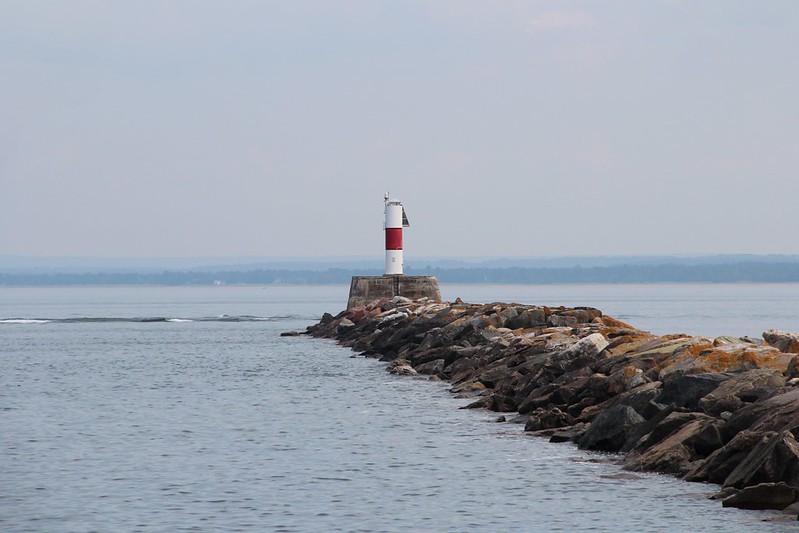
If you have spent any time traveling up around the Great Lakes, you might have observed the structures called breakwaters, which are a feature of many cities with harbors and bays along the lakeshore. Their construction varies, but essentially they are a thin wall or barrier that juts out into the lake in order to do exactly what the name implies—to break the waves that move in toward the shore, creating calm, navigable water on the inner side of the wall for ships and other small craft, while the swells and breakers roll and rage in the great expanse beyond. 

Growing up, every summer we would spend time in Marquette, Michigan, which sits right at the edge of Lake Superior, the largest and wildest of the Great Lakes. There is a breakwater that extends out from the shore there, and when I was young, my family and I would walk out onto it, taking in the views of the water and the city. 

The breakwater in Marquette has been there since the 1800s, reconstructed a few times due to storms, and the first half of it is a sturdy concrete structure, flat easy to walk on in good weather. You can stroll out in this narrow path, the calm harbor to your right, the endless waves to your left, and as a kid it was a thrill to be there on the breakwater, bathed in summer breezes, dancing and skipping out, out, out along the thin line between home and the world beyond, between familiarity and the eternity of blue water stretching toward an unseen shore.

But then there was a point on our walk where we would always stop. About halfway, the breakwater turns at an angle and keeps going farther out into the lake, but this second portion is only comprised of large boulders; the concrete wall ends and from there the going gets slick and treacherous as the waves collide with the bare stone. The only way forward is to scramble and leap and crawl along the rocks. 

My cousins and I always wanted to go onto the rocks all the way out to the end, the very end, where a light tower marked the edge of the breakwater. But the adults wisely said no, it wasn’t safe. So we would turn back. 

And what I could not have perceived then, but that I do now—more and more so with every passing year—is that life is much like that walk along breakwater. When we are younger, setting out into the wide expanse of the world is deliriously exciting, and, if we are blessed with a kind and caring childhood, we take for granted, perhaps, the solid structures beneath our feet. Stay on the straight and solid path, we are told, and all shall be well, and if you are careful, the waves will not break over you, and you will go as far as you need to go. 

But then, somewhere along the way, we get to the place in our lives where the solid footing ends, and we realize, with some surprise and trepidation, that we are no longer children, and that now we are expected to keep going. 

We discover that growing up and growing wise means that the journey does not, in fact, end at the bend in the path, but that life keeps going, going out where there are only rocks to traverse, where the water licks at our heels and sometimes threatens to sweep us away, out where we must indeed scramble and leap and crawl on our knees, and the walls we relied upon for safety suddenly seem much more permeable than they once did. 

One of the times I realized this was when my father had his first major heart attack in late spring, several months before he died. As it happens, I flew into Marquette, where he was in the ICU, and I remember seeing the lake as we drove through town in between hospital visits, and I remember seeing the breakwater, too, curling like a question mark out into the blue expanse, a reminder of simpler springs. 

And I remember feeling, in that moment, like my own solid path had ended, but that I was now required to keep moving forward out where there were only rocks ahead, with no one there to call me back.  I suspect most of us have had experiences like that.

And, in our passage from John’s Gospel today, this is also such a moment for Jesus, where the solid path he has been traveling since the day he was born comes to a precarious place , and when he, too, accepts that he must still keep going, out, out, onward, to where the footing is uncertain and where there is no guarantee of safety. 

“Now my soul is troubled,” he says. “And what should I say—‘Father, save me from this hour’? No, it is for this reason that I have come to this hour.”

Just as the other Gospel authors record his struggle in the Garden of Gethsemane, here John depicts Jesus at the edge of his own understanding, wrestling to reconcile the deep love he shares with his Father with the dawning sense that this love is no guarantee of preservation. Quite the opposite, in fact—this love for the Father is now clearly an invitation, a call, out onto the rocks where certainties end and faith alone must guide him. 

This love that has been growing in Jesus, that has been manifesting in his deeds and his teachings, this love that has bathed him in clear, calm living water, is now rolling in like a wave, rolling in from the unseen shore, and he knows, now, that to be all that he must be, to do all that he must do—for himself, for us—the wave must break over him, come what may, and the rock must be the place where he plants his feet and carries his cross and builds his church, the rocks where the walls of safety, the walls between heaven and earth, the walls between familiarity and eternity, seem much more permeable than they once did. 

It’s interesting, too, that this moment occurs alongside Andrew and Philip, who have been asked by some Greek believers to come and “see” Jesus, echoing Andrew and Philip’s own encounter with Jesus at the beginning of John’s text. Because inasmuch as this passage is Jesus reckoning with the nature of his own journey, it is also a moment for his disciples—including us—to reckon with ours. For “where I am, there will my servant be also.” If we are to follow Christ, then the rocks and the waves beckon us all. 

And our reaction to this realization might depend on where we stand. If we have become too comfortable in our faith, if we have become accustomed to solid ground beneath our feet, if we have not dared to venture out to the places where love requires us to risk something, then we, too, might feel our souls troubled by Jesus’ call. 

If so, then today we are being asked to take one small step outward onto the rocks—one small step towards admitting that we don’t have all the answers, ones step towards being vulnerable, towards embracing new ideas, new relationships, new ways of opening our hearts, new ways of standing with the poor and the forgotten and the storm-tossed—so that we might follow the path that Jesus has already traversed.

But if you are already out there on the rocks, somewhere between scrambling and leaping and crawling on your knees; if you already know all to well what it feels like to have left your certainties and safety behind, then perhaps Jesus’ call will be a consolation, because you will come to understand that even when the path crumbles under your feet, you are not lost. For this, too, is part of the path. 

And this is, in fact, the part of the path that we must travel if we ever want to grow up, if we ever want to grow, to reach that place where familiarity and eternity meet, where home and heaven lap up against one another: out, out at the outermost edge where Jesus abides, where he burns like a light at the end of the breakwater, at the end of every journey, drawing all people to himself, blessing every rocky path you have walked, every crashing wave that has washed over you, and every weary heart, including yours.

I have not been out on that breakwater in Marquette for many years, now, but I hope to go back someday. I still have a little bit of my father’s ashes, and if I can, I’d like to sprinkle a few into the lake there. But I am no longer a child, now, so I think that when I go, I’ll venture out a bit farther out onto the rocks to do so, to let his ashes mix with the water and the wind. It feels right, somehow, that this is how it must be, and where it must be, on that thinnest of lines between home and the world beyond. 

And though my feet might be a little unsteady, and my eyes might sting, I think my heart will still dance and skip like it once did.

It will not be entirely safe. Life never is. Love never is.

But it is still part of the path. And God will be there. 

Foraging: A Sermon

I preached this sermon on Sunday, March 1oth, 2024 at St. Anne Episcopal Church, West Chester, OH. The lectionary texts cited are Numbers 21:4-9 and John 3:14-21.

A few years back, while I was finishing up my seminary studies in Berkeley, I did a very northern California sort of thing—I enrolled in a weekend seminar to learn how to forage for wild mushrooms. 

Now, I like eating mushrooms as much as the next person, but I had never really thought much about going out and picking my own. I am by no means a wilderness expert, but I did grow up watching the 1980’s cartoon David the Gnome, which is set in the woods, and from that I had a vague sense that going out into the forest and eating the things you find there is a risky thing to do.

Nonetheless, the idea of hiking through the redwoods and learning more about mushrooms sounded intriguing, (and honestly when I was a kid, I kind of always wanted to be David the Gnome with his little red cap) so I went for it. 

A group of us gathered on a Friday evening in this little lodge in the forest, the foggy ocean air hovering in the trees outside, and we sipped peppermint tea and listened to a lecture about mushrooms—how all those random little growths you see springing up out of the dirt are not standalone entities, but really just one piece of a vast underground organism called a mycorrhizal network—hidden filaments of fungi intertwined with tree roots, all nourishing one another in the soil. 

So when you encounter a mushroom in the woods, what you are seeing is the visible manifestation of a vast, deep, mysterious life force, and it’s true, some are dangerous and some are not, but all of them are connected.

And, as I learned the next day when we went out, field guides in hand, it is quite difficult to tell the difference between the dangerous and the merely delicious. For example, there is a plain white mushroom called the field mushroom—perfectly fine to eat, looks like the kind you see in the grocery store. However, there is another white mushroom, very similar in appearance, and it is called the Destroying Angel, and as the name indicates, you probably don’t want to take it home and put it in your pasta sauce.

Now, I did pick a few mushrooms, and I even went so far as to cook a few of them and eat them—tentatively, prayerfully—but I will tell you upfront, that despite the increasing amount of gray in my beard and my penchant for wearing little hats, I am not David the Gnome, and mushroom foraging has not become a regular hobby. Even with that field guide, I would not trust myself to judge between a good mushroom and a bad one. 

Instead, what I took away from that weekend is that it is better, perhaps, to simply enjoy walking through the forest, to behold all the mysterious fruits of the dark earth without trying to consume them. Not everything is meant to be easily digestible. 

And you know, it’s funny, but that memory came to mind this week because I was thinking about how Christianity has, at times, misunderstood its purpose—that we decided somewhere along the line, mistakenly, that our mission was to make the world easily digestible. That we decided our vocation was something like foraging for mushrooms—arming ourselves with the Bible as if it were a field guide, going out into the wild with our little notes to judge what is “good” and what is “bad”, and harvesting whatever is deemed useful to us. And to the extent we have done so, then I think we have missed the point of church. 

Case in point: consider our reading today from John’s Gospel. John’s is the most poetic and mysterious of all the Gospel texts—and yet this one piece of it, John 3:16, has been, in our culture, reduced down to a slogan, a bumper sticker version of the good news, a smiling little phrase employed by those who think of Christianity as a binary system designed to differentiate between the saved and the condemned, the insiders and the outsiders.  

With John 3:16 (and a few other passages) people go out into the world and declare those who conform to their interpretation of it as useful and good, and those that don’t as something dangerous, something poisonous, something definitely unworthy of being brought to the table. 

But I will confess to you, I don’t think John 3:16 is about insiders and outsiders and I don’t think our faith is like foraging for mushrooms. I don’t think Scripture is a field guide, a rule book for knowing what is dangerous and what is not. I don’t think anything that we are up to here is as simple and safe as all that, because encountering God is not simple or safe. 

And if you need a reminder of this, then look at the line that comes just before John 3:16:

Just as Moses lifted up the serpent in the wilderness, so must the Son of Man be lifted up, that whoever believes in him may have eternal life.

The idea that Jesus is somehow taking the place of that bronze serpent in the Book of Numbers should startle us, unnerve us a bit. 

Because that story from Numbers is itself a strange and unnerving story, one in which the wounding and healing powers of God collide, forcing the Israelites to realize that there is nothing simple or tidy about their salvation—it is not, as they might have assumed, about choosing between the poison of Pharaoh and the benign, edible pleasures of God—it is about surrendering to a path, a promise, a future that defies easy categorization because it is real, it is true, it is of God

And God will be who God will be, both mighty and gentle, both tender and wild, and God expects that his people will walk in that fullness of truth, as ones who are wise and brave, not those who settle for simplistic answers and well-ordered oppression. 

God wants Israel—and all creation—to share in his wholeness, to be complete, to be overflowing with all that life has to offer, and, then as now, one does not achieve that by dividing the world into overly simplistic binaries of good and bad, useful and worthless. One has to throw out the notes, so to speak, and face life—all of life—as it is, and love it anyway.

And so Jesus, in comparing himself to the serpent, has come to remind us of the same thing. He has come to embody in himself that same collision of wounding and healing that is real life. He has come to crucify our binaries. He has come to invite us to take part in an existence that is mighty and gentle and tender and wild—an existence that approaches wholeness. 

He is the One who calls us to go out into unfamiliar places, to walk through the forest, to behold the mysterious fruits of the dark earth without trying to consume them. He is the One lifted up so that we will understand—at last, or for the first time—that love is not the absence of danger, it is the thing that survives danger. It is the thing stronger than fear. Love is like the mycorrhizal network that underlies everything—and the purpose of our faith is not to outsmart it, to escape it, but to participate in it. 

And no bumper sticker, no cherry-picked verse of Scripture, will ever suffice to convey this. Only a life lived in the wholeness of the love of Christ will convey this.

God so loved the world that he sent his only Son—his own life, his own self—to show us that everyone and everything belongs, and that all of it is worth saving—the good and the bad, the poisoned and the beautiful, the sinful and the sublime. And not by reciting a formulaic prayer, but by enmeshing our lives into the vast mystery of creation. 

So woe to anyone, to any church, to any Christian, who takes it upon themselves to consult their little notes and declare who and what is worthy, as if the world were ever that simple, as if  the truth about any of us could ever fit such neat categories, as if anyone could ever be sure what is in and what is out.

No, far better for us to toss out the field guide. Far better to go out into the world each day to simply marvel at what we find there, even if we do not understand it. Better to love all of it without discrimination. And better to trust that in doing so, we will live into the one simple piece of guidance that God has ever given for navigating the wild: to see and to proclaim that everything belongs. Nothing is forsaken. And we are all part of of that vast, deep, mysterious life force welling up from beneath the surface of things.

That’s what Christianity is about. 

It may not fit on a bumper sticker, but it sounds like pretty good news to me. 

Notes on a Dance: A Sermon

I preached this sermon on Sunday, March 3, 2024 at St. Anne Episcopal Church, West Chester, OH. The lectionary texts cited are Exodus 20:1-17 and John 2:13-22.

I am a big fan of the ballet—some of you know that I worked for the Nevada Ballet for a number of years before seminary. Behind the scenes, though—I was never a graceful dancer!

Working there, I saw a lot of ballets over the years. And one of those, in 2013, was a touring centennial performance of The Rite of Spring, an infamous ballet first performed in Paris in 1913. 

Now if the thought of ballet makes you feel bored or sleepy, stay with me—because The Rite of Spring was not (and still is not) what anyone thinks of when they think of ballet. There is no dancing on pointe, no tutus. The music is not pretty. The whole work—the score by Stravinsky and the choreography by Vaslav Nijinsky, is harsh and unsettling. The ballet portrays a fictional ritual dance done by pre-Christian Russian peasants, where a Spring Maiden is selected and ultimately dances herself to death as a sort of sacrificial offering. Cinderella it is not. 

When I saw in on tour, I felt a little overwhelmed and disturbed by the whole thing. But back in 1913, when it premiered, the audience lost it. It touched some strange nerve deep within them. People started screaming at the stage and throwing things at the orchestra, and then they started shouting at one another and starting fights, and the police had to be called in, even as the dancers and the music kept going. 

Critics called the performance “barbaric” and “in complete opposition to the traditions of classical ballet,” without realizing that this was, in fact, the entire point. The Rite of Spring was meant to be challenging, to point to something wild and uncontrollable that lay pulsating beneath the benignly oppressive surface of our social and political structures. It was an artistic premonition of sorts for a society that was, in 1913, already on the precipice of its own tumble into war-torn barbarity. 

The Rite of Spring was only performed a few times, and after World War I, the music survived but the ballet was considered lost. The choreographer had suffered a mental breakdown, and nobody else seemed to have preserved the dance notations. Perhaps some felt it was best left forgotten anyway. Too raw, this dance, too zealous, too much a reminder of things that people would rather forget.

It wasn’t until the 1980s, when a copy of the those dance notes was found tucked away in the cupboard, that the ballet was brought back to life, to shock and unsettle and invigorate new audiences, including me. 

We rely so much on the notes we take down. Notes of information, notes of music, notes on a dance—they are what help us perpetuate ephemeral, fleeting encounters with truth, including the unsettling truth, so that future generations can know what it felt like to see what we have seen, to feel what we have felt, and in so doing, to rediscover something about themselves.

It’s the same reason, here, that we sing the old hymns, pray the old prayers, and, above all, hear the old readings, year after year, even the ones that challenge us—for they, too, are something like notes on a dance—a very old dance, indeed, one even more elemental and uncontrolled than The Rite of Spring. A dance that, in today’s readings, begins like this: 

Then God spoke all these words: I am the Lord your God, who brought you out of the land of Egypt, out of the house of slavery. You shall have no other gods before me. 

I know, we don’t tend to think of the Ten Commandments as a series of dance steps. Maybe that sounds a bit absurd. The Ten Commandments are weighty things in our cultural imagination—words carved into stone tablets, all the “thou shalt nots,” words of stony solemnity, words thrown like stones at the unworthy: immovable, fixed, and cold. 

But what if the Ten Commandments were not meant to be rigid and heavy at all? What if these notes, given to Moses from amidst the wild, dancing, fire-lit darkness atop Mt. Sinai, are in fact something quite different, quite dynamic?

Because we must remember that God gives the Ten Commandments to Israel while they are in the middle of their wilderness journey—out where there are no courts or palaces or temples. They are notes given to a group of lean, hungry dreamers, the salt of the Red Sea still clinging to their skin, the impassive judgments of Pharaoh weighing on their memories. 

But God speaks to them and says, I am the Lord your God, who brought you out of the land of Egypt. I am not Pharaoh. I have brought you out not so that you might be crushed under the heaviness of another oppressive system, but so that you might LIVE with me. So that you might DANCE with me.

I, the Lord your God, I am the artist and you are my beloved work! Understand: I have guided you through the raging, dancing waters of the sea, under the pirouetting pillars of cloud and fire and now, my children, I am giving you notes on this dance. I am teaching you, in ten steps, how to keep dancing. 

These commandments I give you are not a stone around your neck, they are the choreography of your liberation, so that you and your descendants might never again be bound by the forces that oppress and constrain. I give you these commandments, these notes, so that the dance will never be lost, so that it will keep going, so that you will teach it to the rest of the world. 

It’s funny, though. Even with the best notes, the interpretation can get a bit muddled after a while. And maybe the the power of those ten commandments, the wilderness intimacy upon which they were founded, became dulled by the passage of the years, such that people began to forget it was ever a dance at all.

Which makes Jesus’ entry into the Temple, his big show of flipping of tables and driving out the livestock so very interesting. What was his purpose in doing this? Was he staging a protest against the system? Was he simply angry in the moment? 

We could interpret it in many ways, and people do, of course, but to me there has always been something of the artist about Jesus in this moment—something visionary and deliberate and creative in his action, his all-consuming zeal. It is performative, not in the hollow sense, but in the sense that he is showing those around him how to perform—how move in a way that is expressive of a deep and fundamental truth. Sort of like…a dance.

And I imagine that some of Jesus’ critics said that he was being barbaric, that he was in complete opposition to the traditions of classical temple procedure—and they were right. But that was, perhaps, the point. Perhaps it was was meant to be challenging, meant to point to something wild and uncontrollable that lay pulsating beneath the benign surface of the Temple’s social and political structures. Perhaps it was the rite of a new spring about to blossom, and a new sacrifice, too. 

The Son has returned to his Father’s house, and in the turning of the tables and the whip of cords he is saying: I, the Lord your God, I am the artist and you are my beloved work! Have you forgotten the steps? Have you forgotten that I long to be close to you, close as two partners dancing under the stars, close like we were in the wilderness, when I first taught you the choreography of liberation? 

And now I am here, in the flesh, for a revival, to turn these tables over like I once made chariots somersault into the sea, and I do this to save you from forgetfulness, because ultimately this is what you were made for: Not to be the bearers of oppressive regulations as cold and heavy as stone, but to be dancers of a dance as alive and free as the God who made you.

What would our faith look like, what would our church look like, what would our world look like, if we realized that this is what God desired of us? That all of the Commandments and the codes and the practices and the liturgies we follow were designed to help us respond to the deep, elemental music of the earth, and to move in harmony with it? What does it look like for us to respond to that music here at St. Anne? 

What steps would we make together? What small gods would we relinquish? What tables might we overturn? 

Because here’s the thing: just as it was on Sinai, just as it was in the Temple, just as it was when the audience came undone during The Rite of Spring: there is something deep and fierce and strange and beautiful pulsating just under the surface of things, and it is true, and it is alive, and it is God, and he will never be content to let us forget. He is always emerging, the artist with his notes, to remind us who he is, and who we are, and what we are supposed to do.

Our decision is simply this:

Shall we dance?